POS for Retail
 Sales Hub
 Product Hub
 Inventory Management
 Whatsapp Marketing
 Marketing Automation
 Browser Notification
 Email Marketing
 Fusion Mail
 SMS Marketing
 Fusion SMS
How Barcode and QR Code Management Improves Product Operations
Learn how barcode and QR code management improves product tracking, warehouse efficiency, retail operations, and e-commerce workflows.
Product operations depend on fast and accurate identification. If a team has to manually search for a product name, size, barcode, price, or stock record, valuable time is lost and the risk of mistakes increases. As product catalogs grow, manual product identification becomes increasingly difficult, especially in retail stores, warehouses, distribution centers, and e-commerce operations. Barcode and QR code management solves this challenge by creating a direct connection between physical products and digital product records.
Product Hub supports barcode creation, assignment, and management as part of a centralized product management workflow. Each barcode can serve as a unique product identifier that follows the product throughout its operational life cycle. Whether a product is received into inventory, counted during stock audits, transferred between locations, or sold at a retail checkout, the barcode provides a fast and reliable way to access the correct product record.
This standardization reduces manual data entry and helps improve operational accuracy. Instead of searching through product lists or relying on product names that may be similar, teams can scan a barcode and immediately access the correct product information. This becomes particularly valuable for businesses managing large product catalogs with multiple categories, variants, and locations.
QR codes can add another layer of operational efficiency. While barcodes are primarily used for identification and inventory processes, QR codes can provide access to a broader set of information. A warehouse employee may scan a QR code to view product details, images, supplier information, handling instructions, or inventory records. A retail team member may use the same code to quickly verify product information or locate a product within the system.
Product Hub highlights QR code generation as a practical way to improve warehouse and retail workflows. By making product information easier to access in the field, QR codes help teams work faster and reduce dependency on manual searches or disconnected documentation.
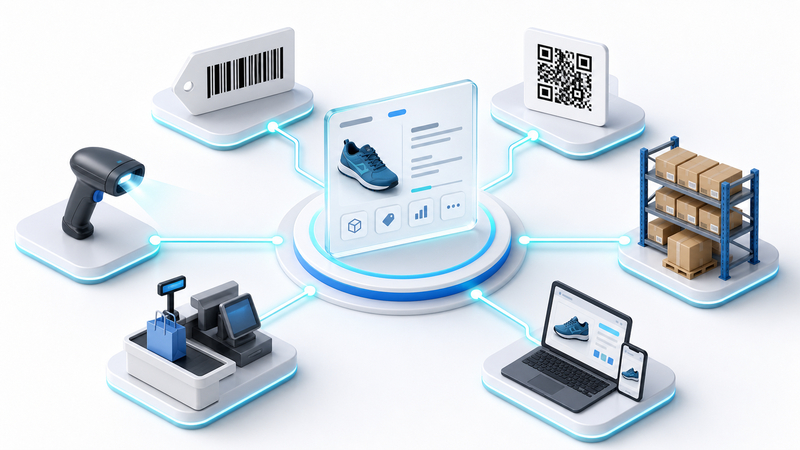
The operational value of barcode and QR code management increases when these tools are connected to a centralized product database. In many businesses, barcode records, inventory data, pricing information, and product details are stored in separate systems. This fragmentation creates inefficiencies and increases the likelihood of errors.
Product Hub keeps barcode data, QR codes, product details, stock information, pricing structures, variants, and channel settings within the same platform. Because all product-related information is connected, teams can move between inventory management, product identification, and operational reporting without switching between systems.
Barcode and QR code management also plays an important role in inventory accuracy. Faster product identification helps reduce stock counting errors, improve inventory visibility, and create more reliable inventory records. This can be especially valuable during stock audits, warehouse receiving processes, and multi-location inventory management.
For businesses operating across multiple stores or warehouses, barcode-driven workflows create greater consistency. Teams follow the same identification process regardless of location, reducing training requirements and helping maintain operational standards across the organization.
Many business owners searching for ways to manage product barcodes or use QR codes for product tracking focus only on generating the codes themselves. In reality, the code is only one part of the process. The real value comes from connecting those codes to a centralized product management system where product information, inventory, pricing, and operational data are managed together.
Product Hub provides that connection. By combining barcode management, QR code generation, inventory visibility, and product data management within a single platform, businesses gain a more efficient and scalable way to manage product operations. The result is faster access to information, fewer operational errors, and greater control over products throughout their entire lifecycle.