POS for Retail
 Sales Hub
 Product Hub
 Inventory Management
 Whatsapp Marketing
 Marketing Automation
 Browser Notification
 Email Marketing
 Fusion Mail
 SMS Marketing
 Fusion SMS
Why Businesses Need Multiple Price Types per Product
Learn how multi-price management helps businesses manage retail, wholesale, partner, and channel-based pricing from one product record.
Growing businesses often discover that one product does not have only one price. The same product may require a retail price, wholesale price, partner price, distributor price, campaign price, marketplace price, or a special channel-specific price. As the number of products and sales channels increases, managing these prices manually becomes more difficult. Teams may rely on spreadsheets, emails, or disconnected systems, creating opportunities for pricing errors, margin loss, and operational confusion.
A pricing mistake can affect more than a single transaction. Publishing the wrong price on a website, using an outdated wholesale price, or applying an incorrect marketplace price can impact profitability, customer trust, and operational efficiency. As businesses scale, pricing management needs to become more structured and centralized.
Product Hub allows businesses to define up to 10 price types per product. This gives teams a consistent framework for managing multiple pricing strategies from a single product record. Instead of maintaining separate pricing files for different customer groups or sales channels, businesses can organize all pricing information within the product management system itself.
This centralized approach improves visibility and reduces the risk of inconsistencies. When pricing data is managed in one place, teams can quickly identify which price applies to a specific customer segment, sales channel, or business scenario. Product information and pricing remain connected, creating a more reliable operational process.
Multiple price types are especially valuable for businesses operating across retail, e-commerce, wholesale, distribution, and marketplace channels. A product sold directly through a company website may require one price structure, while the same product may have different pricing rules for distributors, partners, or marketplace customers. Managing these relationships manually becomes increasingly difficult as the business grows.
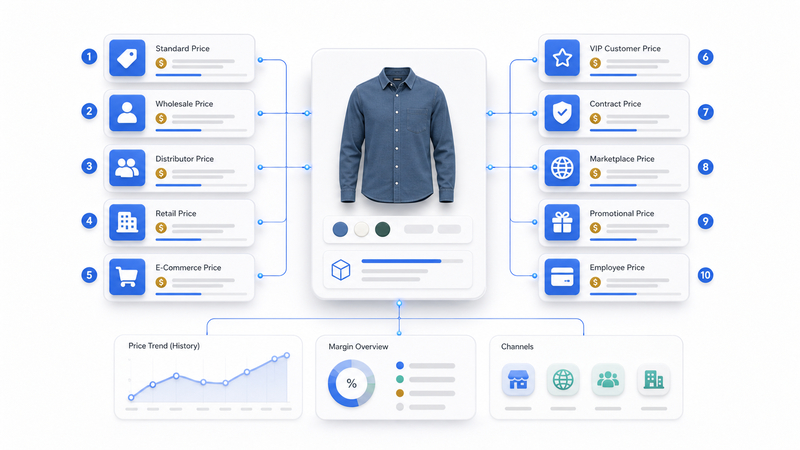
A centralized pricing structure helps prevent incorrect prices from being published, reduces administrative work, and ensures greater consistency across channels. This is particularly important for businesses that sell products through multiple online and offline touchpoints and need clear control over their pricing strategy.
Pricing flexibility also supports promotional and seasonal activities. Businesses can create campaign prices, channel-specific pricing structures, or customer-specific pricing models without losing visibility into the overall product record. This allows pricing decisions to remain organized even when multiple strategies are active at the same time.
Price history is another critical component of effective pricing management. Product Hub includes historical price analysis, allowing businesses to track how pricing has changed over time and compare those changes with product performance. Understanding the relationship between pricing and sales can provide valuable insights for future decisions.
For example, teams can analyze whether a discount campaign increased sales volume, whether a price increase affected demand, or whether a particular pricing strategy improved profitability. These insights become especially valuable in competitive markets where pricing decisions directly influence customer behavior and business performance.
Pricing should not be treated as a separate operational function. It is closely connected to inventory levels, sales channels, promotions, reporting, purchasing decisions, and overall profitability. A pricing decision often impacts multiple areas of the business at the same time.
Product Hub brings these elements together by managing pricing within the broader product management process. Product data, inventory information, channel settings, pricing structures, and performance reporting remain connected within a single platform. This gives businesses better context when making pricing decisions and reduces the risk of disconnected or outdated information.
By centralizing price management, businesses can improve operational accuracy, maintain greater control over margins, and create a more scalable pricing strategy. As product catalogs and sales channels expand, having a structured approach to multi-price management becomes essential for maintaining consistency, supporting growth, and making more informed commercial decisions.