POS for Retail
 Sales Hub
 Product Hub
 Inventory Management
 Whatsapp Marketing
 Marketing Automation
 Browser Notification
 Email Marketing
 Fusion Mail
 SMS Marketing
 Fusion SMS
How Centralized Product Data Speeds Up Retail and E-Commerce Operations
Learn how centralized product data management helps retail and e-commerce teams reduce errors and work from one source of truth.
When product data is scattered, every team creates its own version of the truth. The e-commerce team may use a spreadsheet, the store team may rely on POS data, the warehouse team may update stock separately, and the marketing team may store product images and content in a different location. Over time, product information becomes inconsistent, making it difficult for teams to work efficiently and make confident decisions.
This structure may be manageable when a business has a small product catalog, but it becomes increasingly expensive and difficult to maintain as the business grows. More products mean more categories, suppliers, variants, prices, stock movements, and sales channels. Without a centralized approach, teams spend valuable time searching for information, correcting errors, and manually updating multiple systems.
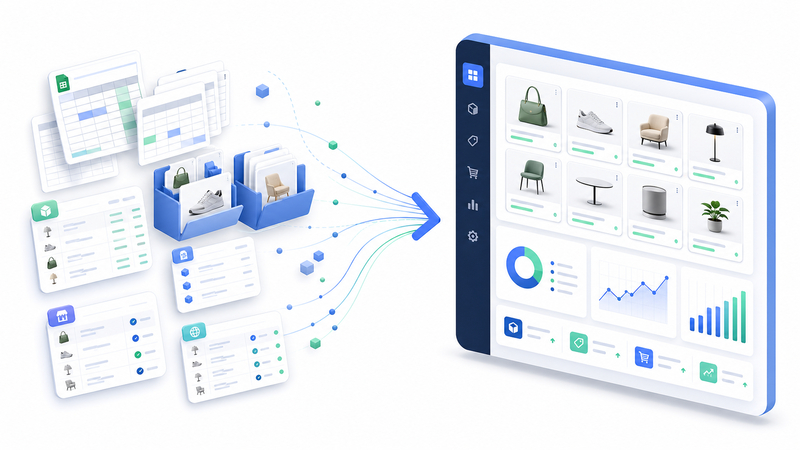
Centralized product data means every department works from a single product record. Product names, descriptions, categories, brands, suppliers, prices, images, barcodes, QR codes, stock levels, variants, and channel settings are managed from one platform. Instead of maintaining duplicate information across multiple systems, businesses create one trusted source of product information that can be shared across the organization.
Product Hub is built around this exact concept. Its goal is to keep product information organized, accessible, and operationally useful throughout the entire product lifecycle. When product data is centralized, updates can be made once and used everywhere. Teams no longer need to question whether they are looking at the latest version of a product record.
For e-commerce teams, this creates significant operational speed. New products can be prepared once and reused across digital channels without repeatedly entering the same information. Product descriptions, images, variants, pricing structures, and channel settings can be managed from a central location. This reduces repetitive work and helps maintain consistency across customer-facing platforms.
Businesses can also determine exactly where products should appear. Products can be published to the company website, online marketplaces such as Amazon or Etsy, or other sales channels based on specific business rules. Not every product needs to be available everywhere, and centralized product management provides greater control over channel distribution.
For retail operations, centralized product data improves day-to-day execution. Store-based inventory levels can be monitored from a unified view, allowing teams to understand stock availability across locations. Product information remains consistent between stores, warehouses, and digital systems, reducing operational confusion and improving inventory visibility.
Barcodes and QR codes play an important role in this process. They connect physical products to the correct digital records, making product identification faster and more accurate. Teams can quickly access product information, stock details, pricing, and operational data without relying on manual searches or outdated records.
Incoming inventory can also be tracked more effectively, particularly when stock entries are connected to invoices and documented transactions. This creates a more transparent inventory management process and improves traceability throughout the supply chain.
Centralized product data also strengthens reporting and business intelligence. Sales trends, top-performing products, category growth, stock planning, inventory turnover, and pricing history all depend on reliable product information. When data is fragmented across different systems, reports become slower to produce and less trustworthy.
When product information is managed through a centralized platform such as Product Hub, reporting becomes more accurate and actionable. Teams can identify opportunities faster, detect operational issues earlier, and make decisions based on current data rather than assumptions.
Ultimately, centralized product data is not only about organization. It creates a foundation for scalable operations. As product catalogs grow and businesses expand into new stores, channels, and markets, having a single source of product truth helps maintain consistency, improve efficiency, and support better decision-making across the entire organization.