POS for Retail
 Sales Hub
 Product Hub
 Inventory Management
 Whatsapp Marketing
 Marketing Automation
 Browser Notification
 Email Marketing
 Fusion Mail
 SMS Marketing
 Fusion SMS
How to Track Store-Based Inventory More Accurately
Learn how store-based inventory tracking and invoice-based stock entry help businesses improve inventory accuracy and control.
Inventory tracking becomes more challenging as soon as a business operates across multiple stores, warehouses, or sales channels. A product may be available in one location, out of stock in another, reserved for online orders, in transit between locations, or waiting to be recorded after a supplier delivery. As inventory complexity increases, businesses need greater visibility into stock movements and availability.
Without a reliable inventory management system, teams spend too much time answering basic operational questions. Where is the product located? How much stock is available right now? Which store is running low? Which products need to be reordered? When inventory information is spread across different systems or updated manually, these questions become difficult to answer accurately and quickly.
Product Hub helps businesses monitor inventory levels across stores from a single, unified view. Because product information and inventory data are managed within the same platform, teams can see not only what a product is but also where it is available, how much stock exists, and how inventory levels are changing over time. This visibility is particularly valuable for retailers, warehouses, distributors, and e-commerce businesses that rely on accurate stock information to support daily operations.
Store-based inventory tracking becomes increasingly important as businesses grow. A product may be selling quickly in one location while remaining overstocked in another. Without centralized inventory visibility, these imbalances can lead to missed sales opportunities, unnecessary purchasing, or excess inventory costs. Product Hub gives teams a clearer understanding of inventory distribution across locations, helping them make faster and more informed decisions.
Accurate inventory tracking also depends on how stock enters the system. Product Hub supports invoice-based stock entry, creating a more structured and traceable inventory process. When incoming stock is recorded directly from supplier invoices, businesses can connect inventory movements to actual purchasing activity. This improves inventory accuracy while providing a clearer audit trail for operations, purchasing teams, and management.
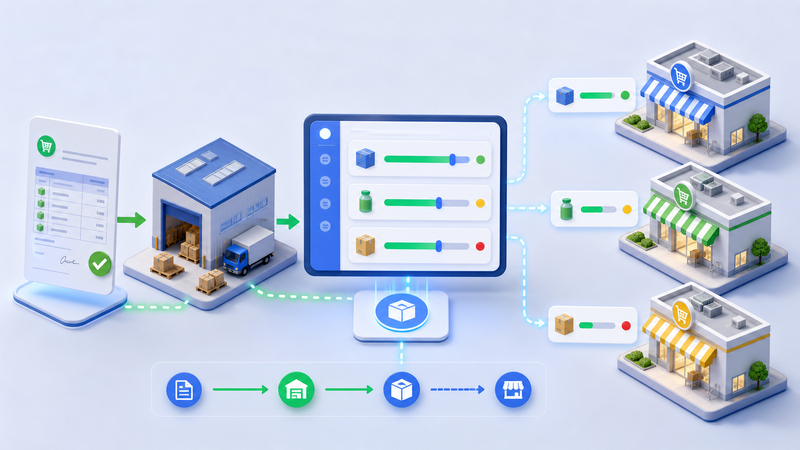
The ability to trace inventory movements is particularly valuable when investigating stock discrepancies, managing supplier deliveries, or reviewing historical inventory activity. Rather than relying on manual notes or disconnected records, businesses can follow inventory transactions through a documented workflow.
Inventory visibility has a direct impact on customer experience as well. Customers expect product availability information to be accurate, whether they are shopping online or in a physical store. If an e-commerce website shows a product as available but the item cannot be fulfilled, customer trust is damaged. Similarly, if stock exists in another store or warehouse but the team cannot quickly identify it, sales opportunities may be lost.
A centralized inventory view helps reduce these issues by giving teams immediate access to current stock information across all locations. Employees can respond to customer inquiries more confidently, transfer inventory when needed, and reduce fulfillment delays caused by inaccurate stock records.
Reliable inventory data also strengthens stock planning and forecasting. Businesses can identify fast-moving products, monitor inventory turnover, understand location-based demand patterns, and anticipate future stock requirements. Instead of reacting to stock shortages after they occur, teams can make proactive inventory decisions based on real operational data.
Product Hub transforms inventory management from a static stock list into a dynamic operational tool. By combining product information, store inventory, purchasing activity, and stock movement data in one platform, businesses gain greater control over inventory performance and can make more informed decisions about purchasing, replenishment, and growth.
As inventory volumes increase, having a centralized inventory management process becomes essential rather than optional. Product Hub provides the visibility, traceability, and operational control needed to manage inventory more efficiently, reduce stock-related errors, and support a scalable retail or e-commerce operation.